Hanjiangwan Foreign Language Specialty School
汉江湾外语特色学校
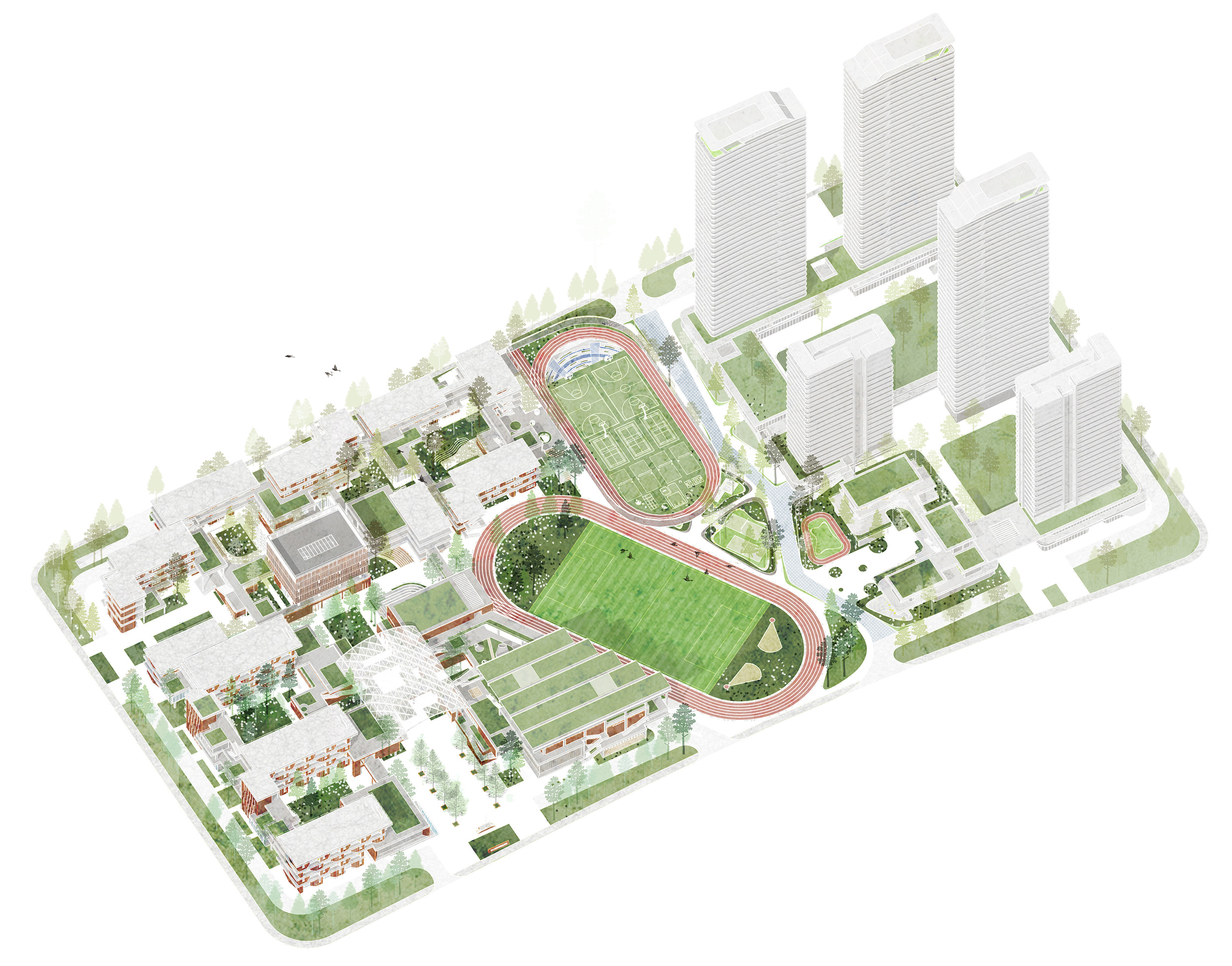
Qiaokou's density pushes the site into a corner: a gas station to the south, a civic park to the east, residential blocks to the north. When the ground is fragmented, the volume must contract. We tried four layouts for the running track and lifted it: a 200-metre raised field, with the school's pedestrian walks freed underneath, K-12 stacked vertically along an L-shaped learning street. A green carpet over the riverbank, a library above the clouds. The project's name is both rhetoric and structure.
- Year
- 2022
- Location
- Wuhan, Hubei
- Typology
- Education
- Status
- schematic
A fragmented site
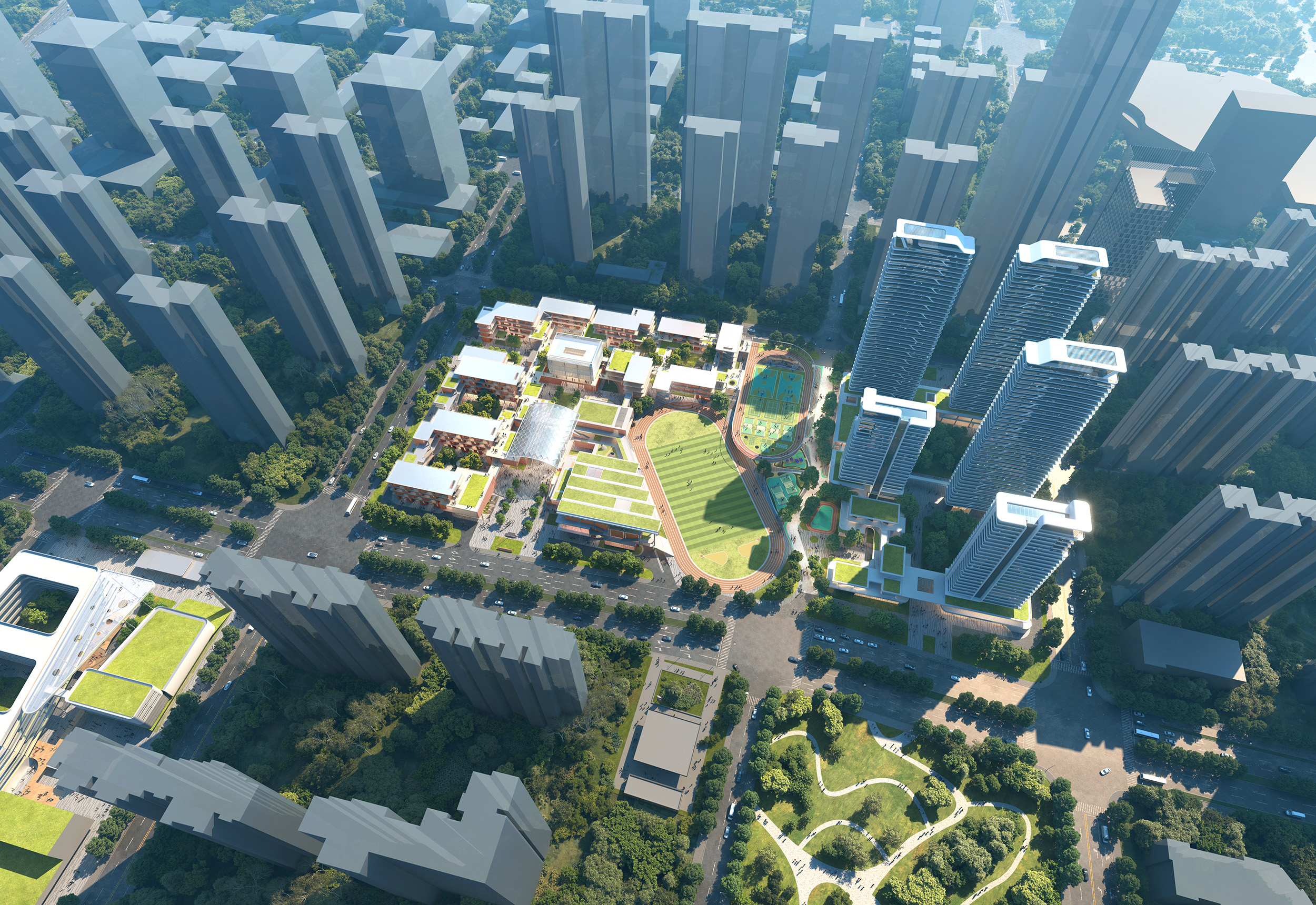
Qiaokou’s interior density arrived before the building did. To the south, a fuel station imposed its safety setbacks; to the east, the civic park held a settled, mature edge; to the north, a continuous facade of high-rise housing pressed in. Three different pressures pushed the site into a corner, and what remained of the buildable outline was cut into uneven pieces. When we read this plot, the first honest thing was to admit it was fragmented: the boundaries refused to be regular, setbacks split apart areas that could otherwise have run together, and four age groups (kindergarten, primary, middle, and senior) had to coexist on the same ground. A conventional courtyard arrangement could not hold them.
Stepping back to look at the surroundings, Hanjiangwan Senior High School sat to the southwest and the all-citizen fitness centre to the southeast, forming a loose triangular dialogue with our site. This meant the campus did not have to seal its posture shut; it could instead concede a corner, let the street and the school give way to one another, and allow some of the city’s public life to seep in. When the ground is fragmented, the volume must contract. This was the first sentence the site spoke to us, and we took it as the starting clause of everything that followed.
Lifting it up
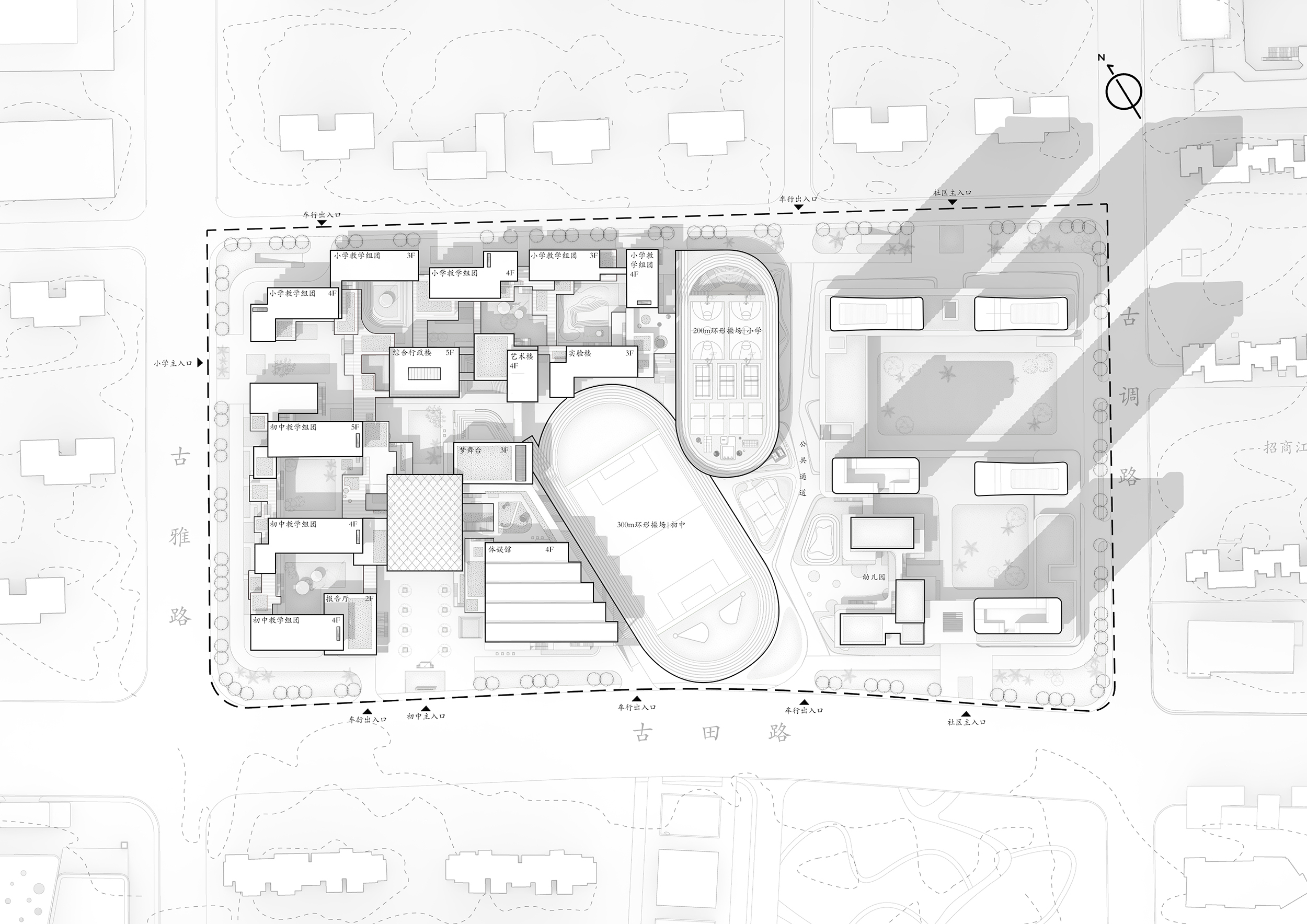
The hardest piece to place was always the 200-metre running track. Its footprint was large, its geometry rigid, and it had to keep clear of the fuel station’s setback to the south. We tested four arrangements: the track placed as a single mass to the south; split between south and north; grouped in the southeast; or lifted on the east. The first three each gave something away: sacrificing the integrity of the buildable area, pulling the campus back into an inward, walled-in posture, or leaving the full weight of the street corner on the surrounding community. What looked like a comparison of layouts was in fact a repeated confirmation of one thing: shuffling pieces in plan had reached the end of what plan could do.
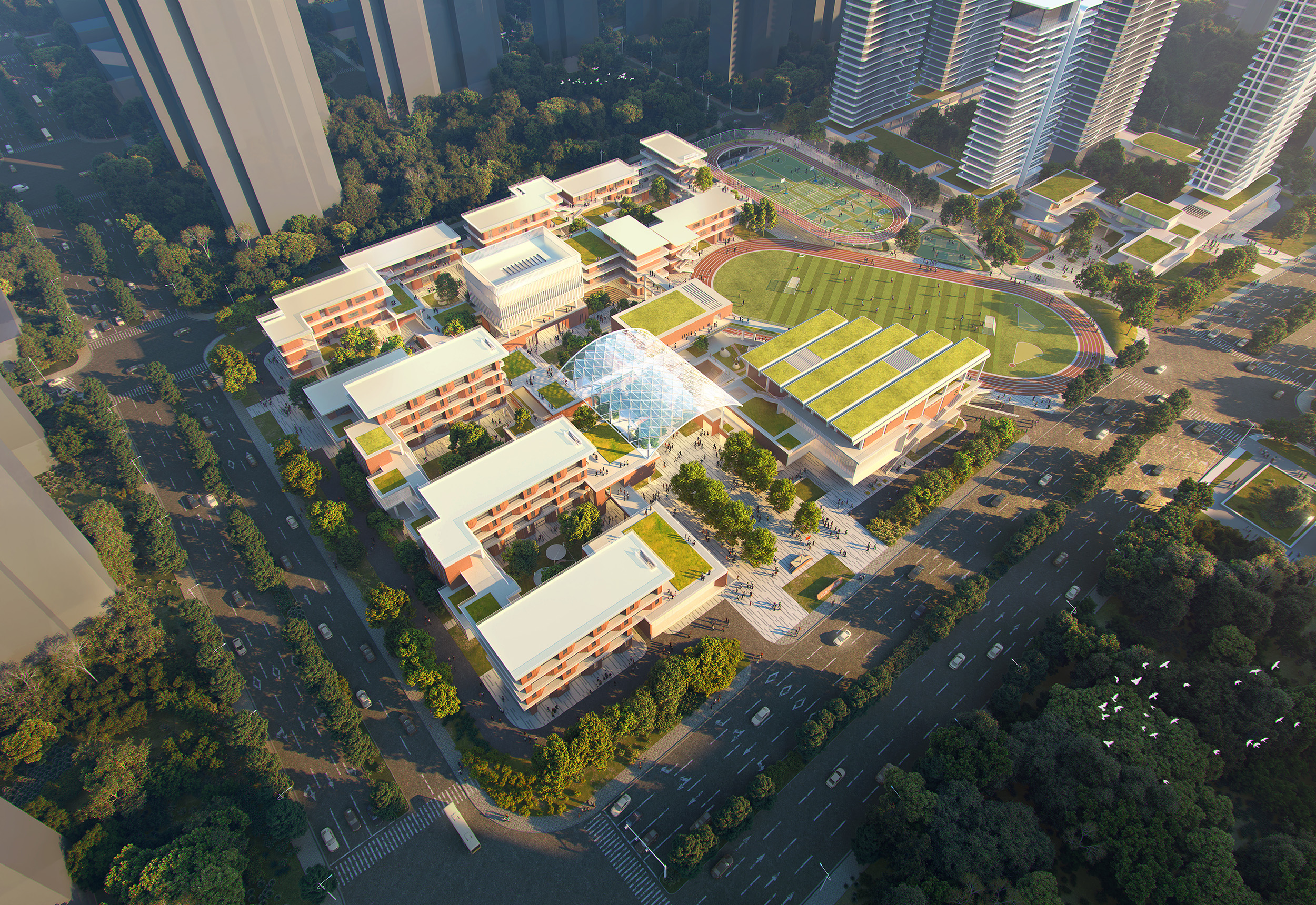
In the end we lifted the track. Once raised, the primary school’s activity surface stayed up in the cloud, and the ground level opened a pedestrian corridor running east to west. The street corner came down with it, no longer a sealed wall, but a place in this dense neighbourhood where the city could draw a breath. That single gesture stitched the fragmented site back together; the parts that setbacks had cut away returned to the campus through the air rather than through the ground.

The learning street and the cloud-top
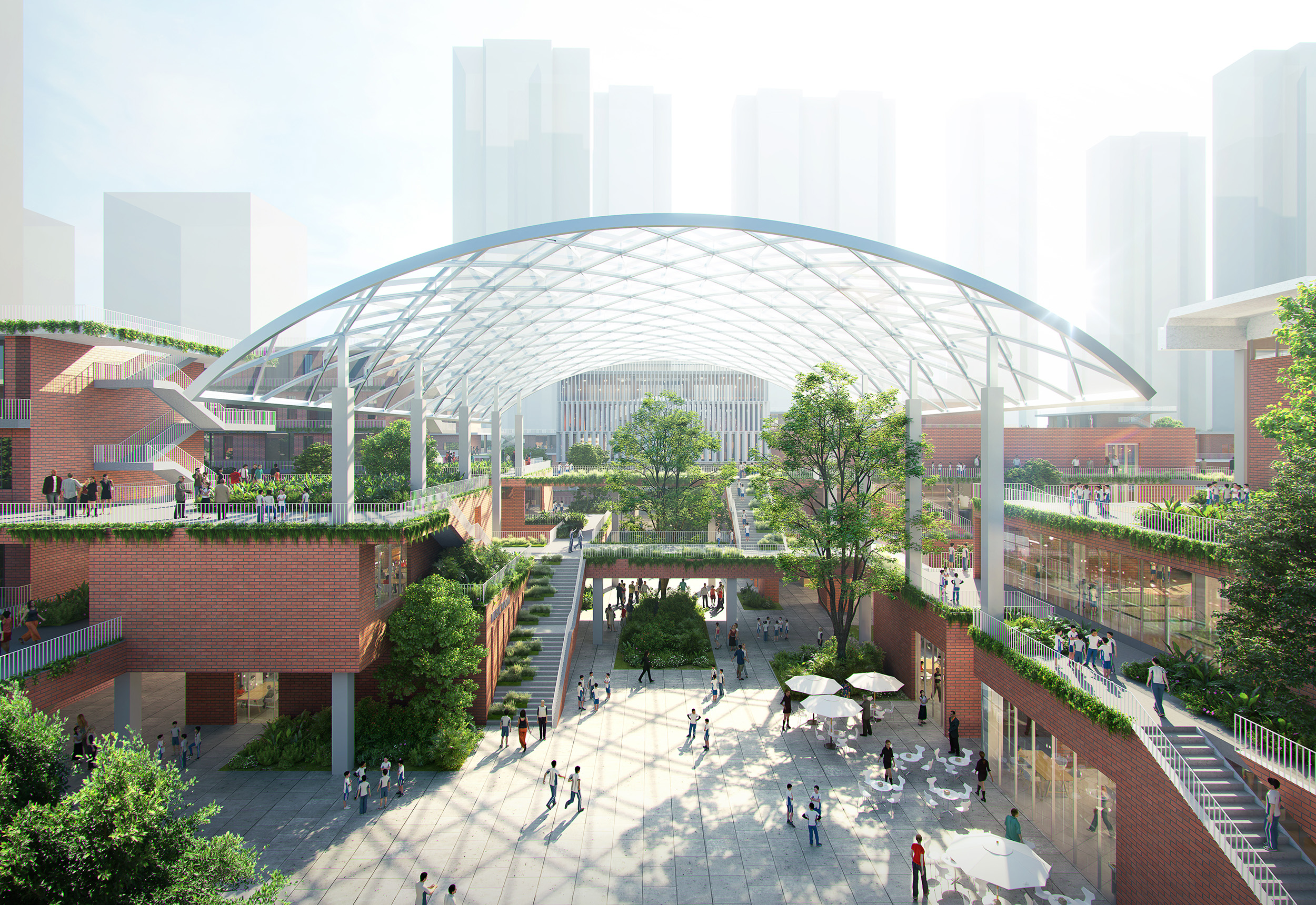
The general classrooms were gathered along the northern edge of the site, threading along an L-shaped learning street: main plaza, cloud-top, main building, primary-school arts wing, and finally ducking beneath the raised athletic field. The street itself stays level, but the building stacks vertically: stairs, sky-bridges, and stepped terraces braid kindergarten, primary, middle, and senior school into a three-dimensional itinerary that walks from the ground all the way up into the cloud.
On the central axis, the cloud-top trellis stands beside the garden library. Beneath the canopy, an irregular cluster forms: sunlight, frame, and courtyard each leaving room for the others, holding small pauses where children can slow down after class. We hoped the restraint here would not read as a stylistic gesture, but as a way of handing the decision back to use itself: a buffer between one age group and the next, a transition between the public and the pedagogical, so that as a child moves through the years they can still find a corner that feels their own. A green carpet over the riverbank unrolls underfoot, and the cloud-top library floats quietly above it. The name and the structure are, in the end, the same thing.